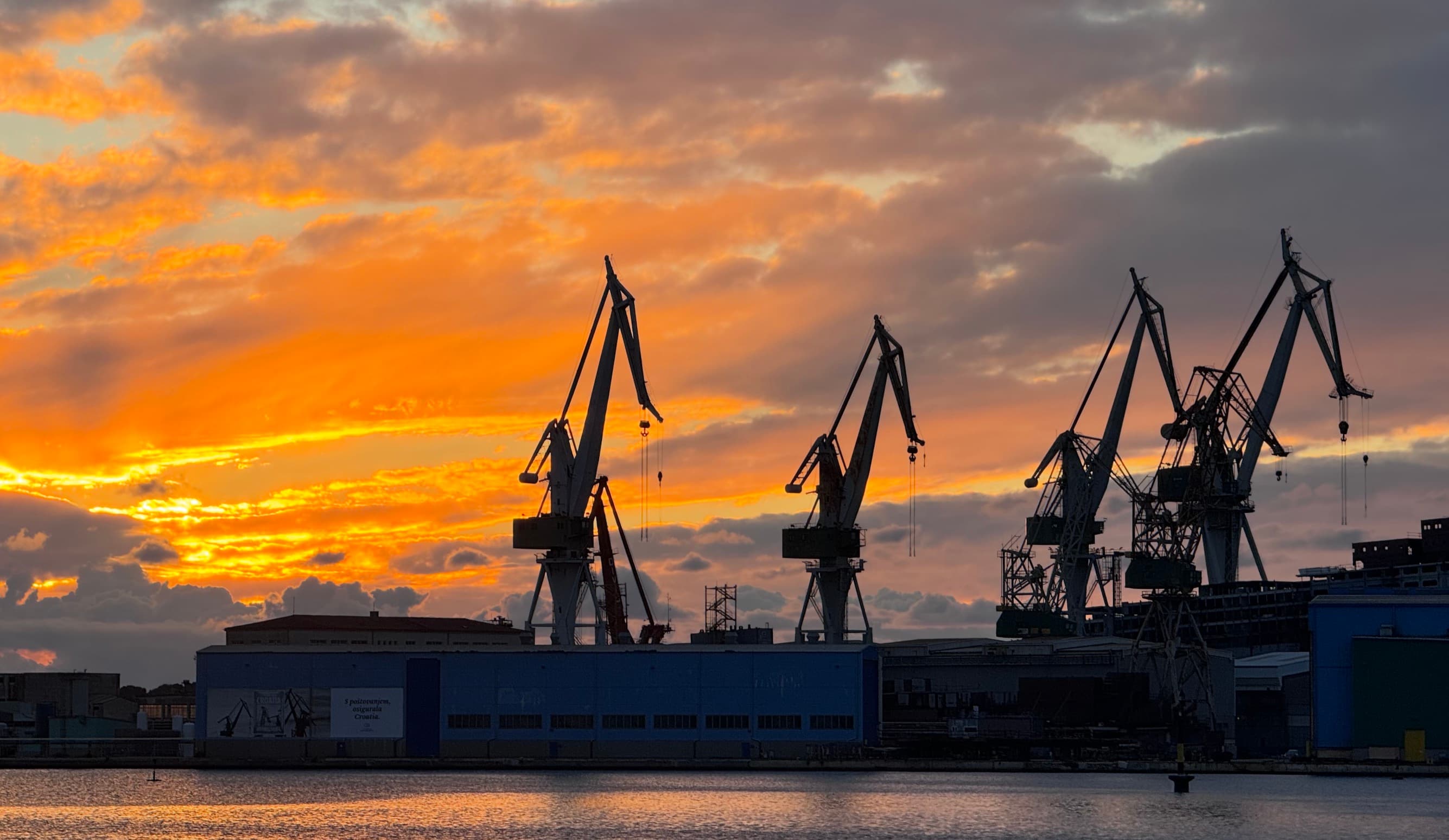
Visitors come to Pula for the Roman stones, and I understand why. But here is something that surprises almost everyone I walk through the city: most of Pula, the actual streets you walk on, the big public buildings, the market hall, the parks, the whole logic of the city, is not Roman and not Venetian. It is Austro-Hungarian, and it was built in one astonishing burst between roughly 1850 and 1914.
The town that almost disappeared
By the early 19th century Pula was nearly nothing. Malaria, plague waves and centuries of Venetian neglect had ground it down to a village of a few hundred people living inside ruins far too large for them. Travellers' accounts from that period describe sheep grazing around the temple and the Arena standing over a swampy, half-empty bay. The censuses of the time count fewer than a thousand inhabitants.
Then the Habsburg monarchy lost Venice in 1866, and even before that, after the revolutions of 1848, it needed a proper naval base on the Adriatic that was not politically Italian. The bay of Pula is one of the finest natural harbours in the Mediterranean, deep, sheltered, easy to defend. In 1856 the decision was made official: Pula would become the central war harbour of the empire, the Kriegsmarinehafen.
What the navy built
What followed was the fastest transformation in the city's three thousand year history. The empire built the arsenal, a shipyard complex that at its peak employed thousands of workers and could build and repair the monarchy's biggest warships. Around it grew everything a naval city needs.
Workers' housing districts, laid out on grids you can still trace in the neighbourhoods around the centre. The naval hospital, at the time one of the most modern in the empire. The Marine-Kasino, the officers' club, which still stands as the Casa della Marina. Schools, barracks, churches for a suddenly multi-ethnic city. The market hall from 1903, an iron and glass building that was genuinely modern for its day and is still where I tell people to buy fruit. The chain of fortifications on the hills around the bay, over twenty forts, whose overgrown remains make for some of the best walks in Pula that no cruise ship passenger ever finds.
The population numbers tell the story better than adjectives can. Under a thousand people around 1850. About 25,000 by 1890. Almost 60,000 by 1910. In two generations, a ruined village became one of the larger cities on the Adriatic.
The city of many languages
Austro-Hungarian Pula was not an Austrian city, not really. The navy brought officers and engineers from every corner of the monarchy. Italian was the language of the old town families and much of the administration, Croatian the language of the surrounding countryside and a growing share of the workers, and on the streets you would also hear German, Hungarian, Czech, Slovene and Polish. Ship crews were famously mixed, orders in the navy were given in a fixed set of German commands precisely because no common mother tongue could be assumed.
James Joyce lived here for a few months in 1904 and 1905, teaching English to naval officers at the Berlitz school, and hated it thoroughly. He called Pula a naval Siberia in one of his letters. I bring him up on tours anyway, partly because the cafe culture he sat in is still recognisable, partly because there is something funny about a city collecting complaints from a future genius the way other cities collect celebrity endorsements.
Where it all went
The First World War ended it. The monarchy dissolved in 1918, and Pula's entire reason for existing, the imperial navy, vanished with it almost overnight. The battleship Viribus Unitis, the fleet's flagship, was sunk right in Pula harbour in the war's final days by two Italian frogmen with a limpet mine, a strange, cinematic ending to the whole era.
What remained is the city itself. When you walk from the Arena toward the centre, most of the solid, dignified buildings lining your way are from this period. The parks, the giardini, the layout of the streets, the industrial bones of the shipyard that still operates today, all of it Habsburg. The Romans left Pula its monuments, but the Austro-Hungarians left it a city.
I run a tour dedicated to exactly this period, from empire to industrial city, and it is the one where I most often hear the sentence: I had no idea any of this was here. That sentence is why I keep doing it.