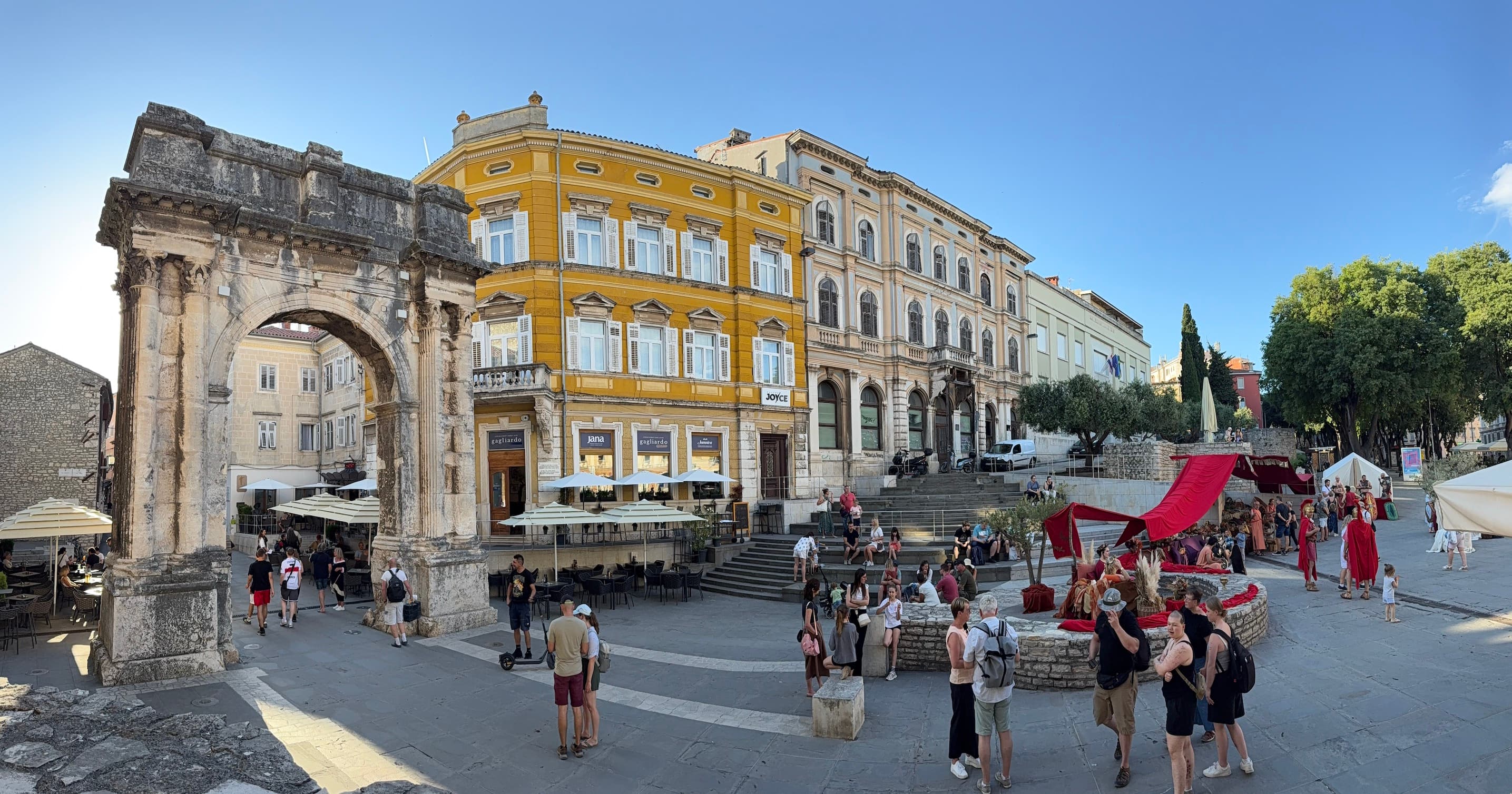
A Monument to the Fallen
When you stand before the Arch of the Sergii in Pula today, you're not looking at a typical triumphal monument. This richly decorated archway, raised inside the Porta Aurea sometime in the last decade of the first century BCE, served a specific and intimate purpose: it was a heroön, a memorial to fallen heroes. The epigraphic content and funerary symbolism reveal that Salvia Postuma commissioned this arch at her own expense to honor three deceased men—Lucius Sergius (son of Gaius), Gnaeus Sergius (son of Gaius), and the youngest, Lucius Sergius Lepidus (son of Lucius)—along with herself as the living matron of the family.
What makes this monument remarkable isn't just its ornate decoration. It's the way Salvia Postuma wove together private grief with public glorification, family honor with imperial loyalty, and personal loss with cosmic symbolism. The arch transforms personal tragedy into eternal commemoration, particularly for the young military tribune Sergius Lepidus, who likely died at the Battle of Actium in 31 BCE.
The Young Tribune's Final Battle
The inscription on the central pedestal of the attic tells us that Sergius Lepidus held the position of tribune in the XXIX legion. This legion was formed by Julius Caesar in 49 BCE, allocated to Octavian Augustus after Caesar's death, and disbanded shortly after the battle at Actium. The premature end to Sergius Lepidus's career indicates he died young, just as he was beginning his ascent through the military and municipal hierarchy. The last post he held was that of tribune—and then nothing more.
The evidence points to a specific conclusion: Sergius Lepidus likely fell at Actium, fighting in the civil war on the side of Octavian Augustus against Marcus Antonius. A premature and violent death, especially of a young soldier in battle, were the prerequisites in the Greek and Hellenistic world for heroization. The central position of his statue's pedestal on the attic marks him as the key figure on this arch. The Victories flanking the archway and the depictions of weapons celebrate not just his military career, but the triumph of Octavian Augustus under whose command he fought.
The Language of Eternal Life
The entire iconographic repertoire on the inside faces of the pilasters and the intrados speaks a clear language: this is about the afterlife, about immortality, about the spirits of the deceased Sergii departing to another form of existence. This aspect of heroization belongs to the customary palette of motifs for building triumphal arches, but it must be clearly differentiated from a tombstone at a place of burial.
The inside faces of the pilasters are covered entirely with reliefs of vineyard tendrils. The grapevine was the protective sign of Bacchus-Dionysus, whose festivals celebrated eternal life. As such, it symbolizes the afterlife. Birds are incorporated into the relief on the north pilaster—ancient Greek funerary symbols of the deceased's spirit, adopted by the Romans. On one section you can see mating birds and a bird pecking at grapes, woven into the vine scrolls.
This combination of acanthus, vineyard tendrils, flowers, and various birds in realistic scenes recalls the Ara Pacis in Rome, where it evokes the diversity and power of life. But the symbolism runs deeper. Fragments from Horace and Virgil reveal that scenes of serpents approaching unprotected bird nests signified hidden dangers lurking during the Augustan golden age and the necessity of a lawful chain of succession in the imperial family.
Guardians of the Journey
Look up at the coffered intrados of the arch, at the triangular spaces between the coffers with their rosettes. These spaces are filled with fantastical and real creatures: hippocampi, ceti, sphinxes, gryphons, dogs, and panthers. Each carries layers of meaning.
The sea-horse with the body and tail of a sea serpent—the hippocampus—appears in two forms: the classical version with a horse's head, and one with the head of a hippopotamus. That hippopotamus head represents Egypt, the important province subdued by Augustus. Along with the sea monster with serpent's body, fish tail and lion's head (the cetus) and the dolphins, these sea creatures symbolize the route of spirits by sea to the afterlife.
The central triangular fields contain a composition of three animals. At the center sits a gryphon with the body of a lion and eagle head turned back, pursuing a fleeing dog. The dog is the faithful companion of the spirit of the deceased, a chthonic symbol reaching back to Greek mythology where dogs guarded the underworld. The second animal, on whose back the gryphon rests its front foot, is a fleeing panther. Panthers accompanied Dionysus and represented the renewal of life through his cult.
The Sphinx and Apollo's Protection
A pair of sphinxes sits in triangular fields to each side of the arch, above the capitals of the pilasters, facing opposite directions with their faces toward the viewer. Sphinxes are guardians of the spirits of the deceased, especially frequent on Roman tombstones. The sphinx has roots in Egypt, where it represented the pharaoh and the solar deity. In Greek culture it gained wings and joined the deities Apollo, Dionysus, and Aphrodite.
The sphinx-Apollo connection is based on association with the sun and the principle of legality and guardianship of order and the rule of law. For Augustus, the sphinx held special significance as guardian of the golden age. After the battle at Actium, he adopted Apollo as his particular patron, and the sphinx symbol appeared on coins immediately following that victory and on his personal seal.
Look at the details where the sphinxes sit. Between them you'll find a palmette, situated in a corner of a coffer with a rosette. This placement isn't coincidental—it replicates the scheme of acroteria on archaic Greek temples. The palmette between two sphinxes symbolizes the tree of life between its guardians, ancient eastern symbols of eternal life.
Gryphons and Eastern Victory
Eagle-headed gryphons appear on the coffered intrados in two types: one with the body of a lion, another with the winding body of a sea monster with fins. In the two triangles that frame the central coffer you see three animals: panther, dog, and gryphon. The gryphon with lion's body, long tail and eagle's head dominates, pursuing the dog and panther.
In Roman iconography, gryphons developed along similar lines to sphinxes, and you often see both motifs on the same monument. Like the eagle, the gryphon in eastern mythologies associates with the solar deity and the heroization of the deceased, accompanying the spirit on the celestial voyage. In the Roman world it represented Apollo, Dionysus, and—from Augustus's time—Nemesis.
The specific motif of a dominant gryphon with its paw on the back of a fleeing panther may connect to Augustus's victory over Egypt and Marcus Antonius. A gryphon dedicated to Augustus's protector Apollo can be interpreted as victory over Marcus Antonius, who adopted Dionysian patronage and is represented by the panther. In combination with Dionysian, fertility and victory motifs, gryphons represent imperial victory over the nations of the East.
Celestial Chariots and Morning Grief
Two figures in light two-horse chariots frame the dedicatory inscription on the frieze. These have sparked contradictory interpretations, primarily because they sit at significant height and the reliefs are quite damaged. Viewed up close, both chariots are clearly driven by female figures dressed in chitons, with cloaks trailing in broad arcs behind their backs and heads.
The iconographic attributes—light chariots harnessed to pairs of horses, chitons, and cloaks trailing in arcs simulating the celestial vault—correspond with depictions of Selene/Luna, the moon goddess. But two opposing figures present an interpretative problem. While mirrored pairs of Victories are commonplace, celestial deities usually appear in complementary pairs. The most appropriate choice to meaningfully complement Selene/Luna appears to be Eos/Aurora, goddess of the dawn, sister to Selene/Luna and Helios/Sol.
This choice carries profound personal meaning. The myth concerns the death of the hero Memnon, son of Eos, under the walls of Troy. The despairing Eos begged Zeus for her son's immortality. The scene of Eos mourning Memnon became a model of motherly sorrow. If Salvia Postuma was the mother of the prematurely deceased Sergius Lepidus and widow of Lucius Sergius, it's understandable that in her grief she equated herself with the dawn deity. The Salvia Postuma inscription—indicating the location of her statue on the attic—sits above the depiction of the chariot driver to the left, the possible Aurora.
Peace, Law, and the Golden Age
A less obvious aspect of the vegetal relief connects to official Augustan state iconography. The harmonious and symmetrical composition of vineyard decoration flowing from acanthus leaves becomes clear when compared with the model presented in the Ara Pacis relief in Rome. Acanthus symbolized Apollo and Dionysus and Liber, and represented the prosperity and abundance of the Augustan golden age, especially when united with grapevine.
Scrolling acanthus with incorporated grapes and birds on the west face of both arch pilasters symbolizes abundance and progress in the Roman empire and in the colony of Pola, to which the Sergii contributed through public service as municipal decurions and magistrates. Reading between the lines of the inscription, the two brothers were the first members of this family to achieve municipal careers, in the first decades of the founding of the Roman colony of Pola, with Sergius Lepidus following in their footsteps.
The harmonious and symmetrical composition of vineyard tendrils on the Arch of the Sergii, with abundant blank space in the background, gives an impression of peace, stability and security. Through the vegetal reliefs on the piers, the symbolism expresses the immortality of the spirit and the message of order in the state and the achieved golden age. All three of the Sergii achieved prominent magistracies in the administration of the Roman colony at Pola, enforcing Roman law. The message of order, just laws, and abundance pertains to their merits in governing the city and to the general prosperity of the empire.
The Eagle and the Serpent
The compositional centerpiece of the arch focuses on the depiction at the top of the intrados: an eagle grasping a serpent in its talons. This scene carries manifold meanings. First and foremost, it's an association with apotheosis—the transition to the afterlife of a prematurely deceased hero. It's also a reminder of Augustus's victory in the naval battle at Actium in 31 BCE.
At its semantic core, the arch celebrates the triumphator, equating him with Jupiter to the maximum permitted extent. The eagle represents Jupiter, and thereby the triumphator—in this case, Emperor Augustus—victorious over his enemies just as the eagle overcomes the serpent. The context of the epigraphic data and iconographic imagery on the arch points to the likelihood that Sergius Lepidus not only fought on the winning side of Octavian Augustus, but fell in that struggle.
The scene of an eagle grasping a serpent appears in classical Greece on reliefs and painted vases. It's held to represent the scene described in Homer's Iliad, interpreted by the Trojans as meaning the fortunes of war would turn against them. The scene became a frequently replicated symbol of Greek victory. In the early Hellenistic period, it took on a new meaning and gained strong funerary connotation as a symbol of apotheosis and passage from the world of the living to the world of the dead. The celestial eagle and chthonic serpent represented two opposing elements, symbolizing the eternal cycle of life: death and birth.
An eagle raising a serpent into the air represents the transition of the spirit from the worldly to the transcendental sphere. Eastern creeds involving an eagle dedicated to the solar deity taking the spirit of a deceased ruler to join the gods were adopted into the Roman imperial cult. The eagle with serpent became the symbol of apotheosis of Roman emperors and empresses.
A Unified Vision
What Salvia Postuma created on this arch was something remarkable: a unified iconographic program that successfully wove together private grief, public honor, funerary symbolism, and imperial loyalty. The unique selection and composition of figural motifs can be attributed to her authorship. She understood how to speak multiple languages at once—the private language of family loss and the public language of imperial triumph.
The arch depicts associations to the Augustan victory over the Parthians in the east: winged Victory with trophy, gryphons and sphinxes, and divine celestial chariots in the frieze. It celebrates the key elements of the imperial cult and triumph, and the allegiance of the Sergii family to Augustus and his policies. The imagery asserts the lawfulness of the authority Augustus inherited from the deified Julius Caesar, the origins of the gens Julia from the goddess Venus, and the divine nature of Augustus himself.
But beneath this public proclamation runs a deeper, more personal current. This is a mother's monument to her son, a widow's memorial to her husband and his brother. It's a declaration that their deaths—particularly the death of young Sergius Lepidus at Actium—were not meaningless, but heroic. That their spirits live on, accompanied by hippocampi across celestial seas, guarded by sphinxes and gryphons, carried by eagles to immortality. That their service to Pola and to Augustus earned them not just civic honors but cosmic apotheosis.
The Arch of the Sergii stands as one of the earliest arches of the imperial period, among the first to transform the late Republican private arch into something larger: a heroön that unites triumph and apotheosis, private loss and public glory, the mortal and the divine. When you walk through it today, you're walking through a doorway Salvia Postuma built between worlds—between the living city of Pola and the realm of immortal heroes, between personal grief and eternal commemoration.