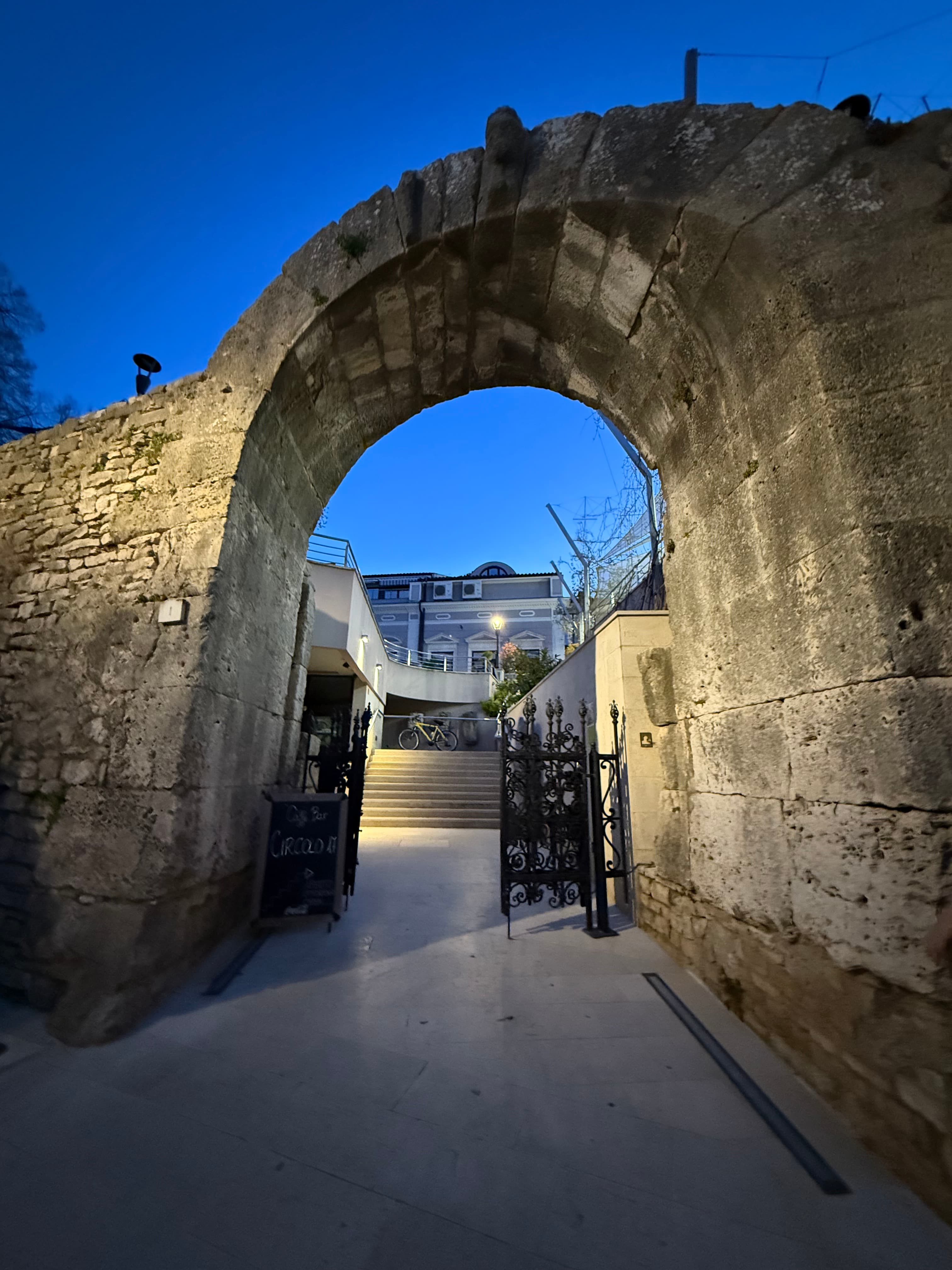
One wall, several centuries
Almost every group asks me the same question when we stop by a stretch of old stone near the center: how old is this wall? And every time I have to disappoint them a little, because there isn't one answer. What looks like a single medieval wall is usually several walls, from different periods, standing on top of each other or patched into each other over a very long time.
Pula had Roman walls first. The city was fortified back when it was a Roman colony, and bits of that original circuit survive, sometimes as actual standing stone, sometimes just as a line you can trace through where later buildings sit. Then the Roman Empire fell apart, the town shrank, and whoever was in charge of defending it in the early medieval period didn't have the resources or the need to build a brand new circuit from scratch. So they didn't. They reused what was there. They patched holes, raised sections that had collapsed, added gates where the traffic actually needed to pass, and left the rest alone if it still did the job.
That's the pattern you see almost everywhere in Pula's old core, not just at the famous Roman monuments everyone photographs. The defensive walls and gates of the city were never a single construction project finished on a given date and then preserved in amber. They were a working system that got maintained, modified, torn down in places and rebuilt in others, depending on who was ruling the town, what weapons they were worried about, and how much money the local authority actually had that decade.
How to actually spot the layers
I tell people on my tours: forget trying to date a wall by eye in one glance, and instead look for the seams. The joins. The places where the masonry style clearly changes partway up or partway along.
Roman stonework tends to be large, regular, carefully fitted blocks, often with very little mortar visible between them because the blocks themselves were cut precisely. Medieval work that reused the same stretch is usually rougher. Smaller stones, more mortar, less uniform coursing, because the people doing the repair weren't quarrying and dressing new monumental blocks, they were working fast with whatever was on hand, including stone scavenged from buildings that had already fallen down elsewhere in town.
You'll also see straight vertical joints where one section clearly stops and a different build starts right next to it, like a scar. Sometimes there's a noticeable step in the thickness of the wall. Sometimes you can spot where a gate opening was narrowed, or where a window or passage from an earlier phase was deliberately filled in with different stone because the defensive need had changed, and a wide opening in a wall is a liability if you're suddenly worried about a different kind of attack than the people before you were.
None of this is me being clever, by the way. It's just paying attention to texture and joints, the kind of thing you start to notice automatically once somebody points it out to you once.
Why this matters more than a date would
I get why people want a single clean number, a year, a name of the person who ordered it built. It makes for a tidier story. But I think the layered version is actually the more honest and more interesting one. Pula's walls survived precisely because people kept adjusting them instead of replacing them outright. Every generation that needed defense here added its own patch, used its own materials, worked to its own standards, and then the next generation did the same on top of that.
So when I'm walking a group past one of these stretches, I'm not really giving them one fact. I'm asking them to see a few centuries of different hands solving the same basic problem with whatever they had. That, to me, is a much better story than a date on a plaque, even when I don't have a precise date to give you anyway. Most of the time nobody does, not with full certainty, and I'd rather be honest about that than invent precision I don't actually have.
Next time you're walking through the old town and you pass a stretch of stone that looks ancient and unremarkable, slow down for a second. Look at the joints. See if the stone size changes. You might be looking at a conversation between builders who never met each other, separated by hundreds of years, arguing in stone about how best to keep the town standing.