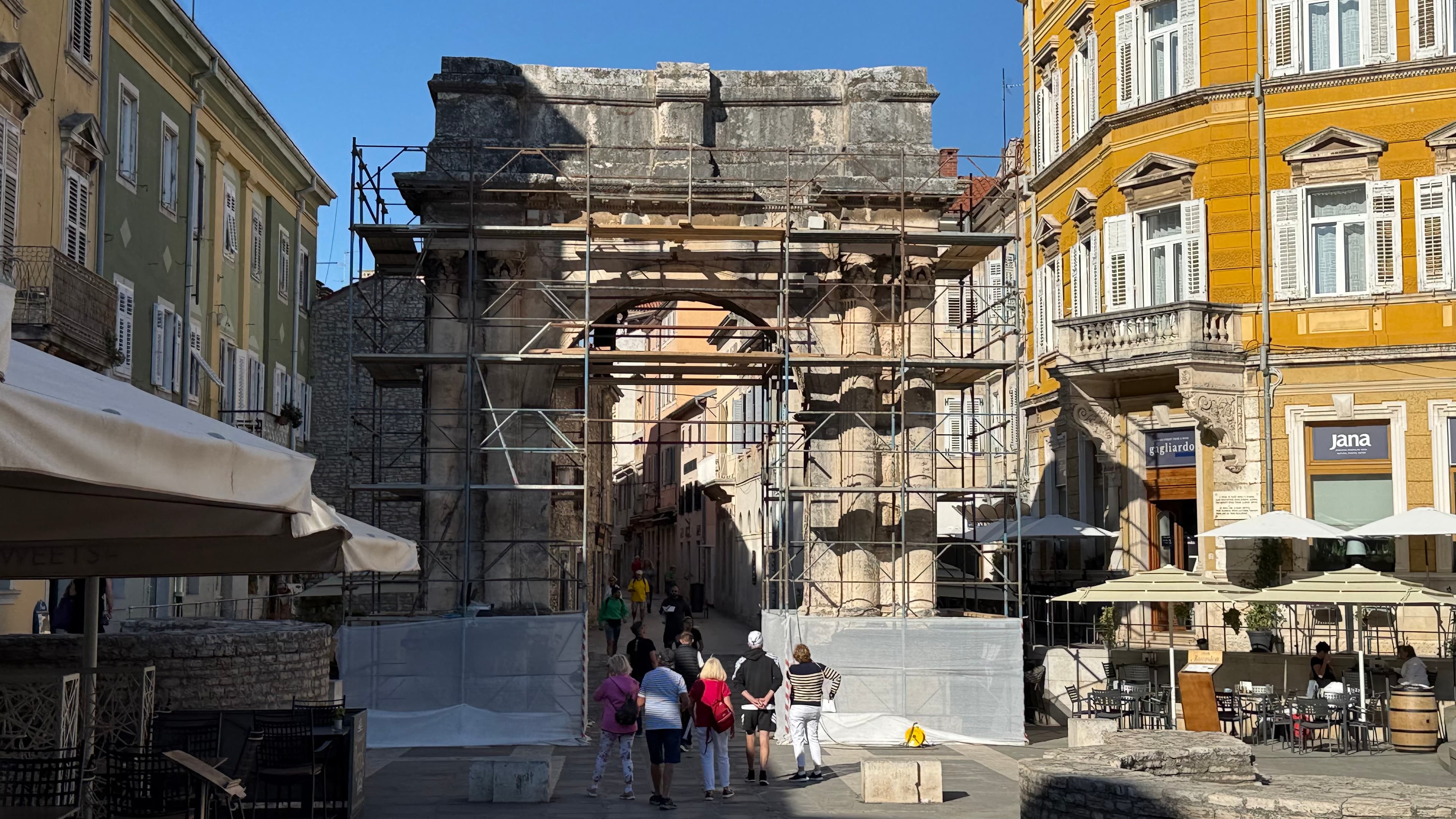
A Woman's Monument
The Arch of the Sergii stands just inside the Porta Aurea of ancient Pola, its western face turned toward the city's heart. Five inscriptions cover its surface, naming three deceased men and one living woman. That woman—Salvia Postuma—paid for it all.
The dedicatory inscription on the frieze states plainly: Salvia Postuma Sergi (uxor) de sua pecunia. Salvia Postuma, wife of a Sergius, built this from her own money. Her name appears again on the attic, between the pedestals that once held statues of the three Sergii men. The fact that she commissioned this arch tells us something critical: all three men were already dead when the monument rose.
This was not typical. Arches in the Roman world usually celebrated living victors or were raised by Senate decree. But the Arch of the Sergii is intensely personal—a private fornix in the late Republican tradition, transformed by Augustan imagery into something more: a declaration of family devotion, a claim to status, and a sophisticated piece of imperial propaganda.
Three Dead Men
The men Salvia Postuma memorialized were her husband's family. The two outer pedestals name brothers: Lucius Sergius, son of Gaius, and Gnaeus Sergius, son of Gaius. Both held the offices of aedile and duumvir in Pola's early colonial administration—the first generation of this family to achieve municipal careers in the newly founded Roman colony.
Between them stands the central pedestal, marking Lucius Sergius Lepidus, son of Lucius. His career ended abruptly. The last post named in his inscription was military tribune of the XXIX legion. That legion was formed by Julius Caesar in 49 BCE, passed to Octavian after Caesar's death, and disbanded shortly after Actium in 31 BCE. The dates tell their own story: Sergius Lepidus likely died young, possibly at Actium itself, fighting in the civil war on Octavian's side against Marcus Antonius.
A premature, violent death—especially of a young soldier in battle—was a prerequisite for heroization in the Greek and Hellenistic tradition. The central placement of Lepidus' statue base makes this clear. He is the focal point. The arch's imagery revolves around him.
Funerary Symbols and Eternal Life
The arch's interior surfaces carry a dense program of funerary symbolism. The inside faces of the piers are covered entirely in grapevine reliefs scrolling out of acanthus leaves. The grapevine belonged to Bacchus-Dionysus, whose festivals celebrated eternal life. In Roman funerary art, it symbolized the afterlife.
Birds appear among the vines on the north pier—funerary symbols of the deceased's soul, inherited from ancient Greek tradition. Two birds are depicted mating; a third pecks at grapes. This scene appears nowhere else on the arch, only on this one pilaster, aligned with the inscription of Salvia Postuma. It may represent the fruitful marriage that produced Sergius Lepidus. The south pier, beneath Gnaeus Sergius' statue, has no birds—possibly a deliberate message that this family member was childless.
The coffered intrados is populated by fantastic creatures: hippocampi, sea monsters (ceti), sphinxes, gryphons, dolphins, dogs, panthers. These are not decorative filler. Each carries meaning. The hippocampi and ceti symbolize the sea voyage of the soul to the afterlife. One hippocampus has the head of a hippopotamus—an Egyptian animal, a deliberate reference to Augustus' conquest of Egypt. The dolphins, sphinxes, and gryphons all point to immortality, apotheosis, and the divine.
At the center of the intrados, framed by dolphins, an eagle grasps a serpent in its talons—the compositional heart of the entire monument.
The Eagle and the Serpent
This scene is rare in Roman art and carries immense symbolic weight. The celestial eagle and the chthonic serpent represented opposing forces in the eternal cycle: death and rebirth. The eagle raising the serpent into the air symbolized the spirit's transition from the earthly to the transcendent sphere.
The motif had deep roots. In Homer's Iliad, an eagle bearing a serpent was an omen of Greek victory. In Hellenistic funerary art, it became a symbol of apotheosis—the passage from the world of the living to the world of the dead. When Alexander of Macedonia died, legend said a brilliant star fell from the sky, a giant eagle appeared, and then returned to the heavens bearing the star—Alexander's immortal spirit ascending among the gods.
In the Augustan period, the eagle took on imperial significance. The eagle represented Jupiter, and thereby the triumphator—in this case, Augustus himself. The eagle's victory over the serpent was Augustus' victory over his enemies. On the Arch of the Sergii, the eagle and serpent declare that Sergius Lepidus, who died fighting for Octavian, shares in that divine victory. His spirit ascends.
Imperial Triumph and Eastern Victory
The arch's imagery carefully links the Sergii's fate to Augustus' triumph. The pair of Victories in the spandrels—one holding a wreath and palm branch, the other a trophy—celebrate military success. The trophy, a spear topped with captured armor, points specifically to the victoria Parthica, Augustus' diplomatic victory over the Parthians and the restoration of captured Roman standards in 20 BCE.
The gryphons and sphinxes reinforce this. Both creatures were solar symbols associated with Apollo, Augustus' patron deity after Actium. Gryphons represented imperial victory over eastern nations. Sphinxes guarded the Augustan golden age and appeared on Augustus' personal seal after Actium. On the Prima Porta statue of Augustus, sphinxes decorate the shoulder clasps of the breastplate—possibly referencing the Parthian victory, possibly the conquest of Egypt, possibly both.
The sea creatures—hippocampi, ceti—symbolize Augustus' naval victories during the civil wars over Sextus Pompeius, Marcus Antonius, and Egypt. The gryphon with a lion's body, depicted pursuing a fleeing panther in the triangular fields of the intrados, may represent Augustus (through Apollo's gryphon) defeating Marcus Antonius (who identified with Dionysus, represented by the panther).
Salvia Postuma wove these elements together deliberately. She was not just mourning her family. She was declaring their loyalty to Augustus and claiming their share in his cosmic, divinely sanctioned order.
The Celestial Chariots
On the frieze, flanking Salvia Postuma's dedicatory inscription, two female figures drive bigae—light two-horse chariots. Their cloaks billow in broad arcs behind them, simulating the celestial vault. These are not Victories, though damage to the reliefs initially caused confusion. They are divine sisters.
One is certainly Selene-Luna, the moon goddess. The other is likely Eos-Aurora, goddess of the dawn. Together they represent the cosmic cycle of day and night, light and darkness, life and death and rebirth. The pairing is unusual—typically, Roman arches and imperial statuary showed Sol and Luna, brother and sister. But Salvia Postuma chose two sisters.
Why? The myth of Eos offers a clue. When her son Memnon died heroically at Troy, the grief-stricken Eos begged Zeus for his immortality. The scene of Eos mourning Memnon became a model of maternal sorrow—a pietà. If Salvia Postuma was the mother of Sergius Lepidus (and the inscription's placement suggests she was), her choice of Aurora makes emotional sense. She identified with the dawn goddess who lost her son.
The alignment is precise: Salvia Postuma's name on the attic sits directly above the left chariot, the probable Aurora. This compositional axis—Aurora, Salvia Postuma's inscription, the mating birds on the north pier—tells a coherent story of motherhood, loss, and hope for immortality.
Peace, Law, and the Golden Age
The vegetal reliefs carry another layer of meaning, tied to Augustan state ideology. The harmonious, symmetrical composition of grapevine scrolling from acanthus leaves echoes the reliefs of the Ara Pacis in Rome. Acanthus was a symbol of Apollo and Dionysus-Liber, representing the prosperity and abundance of the Augustan golden age (saeculum aureum).
The Ara Pacis used this imagery to glorify the peace that followed the civil wars, the legal order Augustus established, the abundance and fertility his rule brought. The motif proclaimed the numen mixtum—the harmonious cooperation of divine forces (Apollo and Dionysus) bringing happiness and the revival of the state.
On the Arch of the Sergii, the acanthus and grapevine on the western faces of the piers—the sides facing the city and its forum—represent the public service and municipal careers of the Sergii. The execution closely resembles the frieze of Pola's Temple of Roma and Augustus, built between 2 BCE and 14 CE. This similarity is one element used to date the arch to the last decade of the 1st century BCE.
The message is clear: the Sergii contributed to Pola's order and prosperity by serving as decurions and magistrates, enforcing Roman law. The harmonious composition, with ample blank space, conveys stability and security. The imperial golden age and the fortunes of the Sergii family are presented as inseparable.
Authorship and Innovation
The unique selection and composition of imagery on the Arch of the Sergii is attributable to Salvia Postuma herself. She was the patron, she paid, and the monument's intricate program reflects choices no committee would make. The combination of private grief, family pride, funerary symbolism, and sophisticated engagement with Augustan imperial ideology is personal and coherent.
She drew on the earliest imperial models—the Actian arch of 31 BCE, which first placed facing Victories in the spandrels of a single-bay arch. She incorporated motifs from Hellenistic royal apotheosis, from Greek funerary tradition, from the newest Augustan imagery. She balanced commemorating three men with asserting her own presence: her name appears twice, her statue stood on the attic alongside theirs, her compositional choices reveal her hand throughout.
The arch unites triumph and apotheosis, transforming the triumphal arch in the Augustan period. It is simultaneously a heroon—a monument to prematurely dead heroes—and a political statement. It is funerary without being a tomb. (No arch in the Roman empire served as an actual burial monument, despite the presence of funerary symbols.) It celebrates military success while mourning military loss. It declares loyalty to Augustus while centering a woman's agency and sorrow.
A Monument of Her Own Making
When you stand before the Arch of the Sergii today, you see what Salvia Postuma built. She took her wealth—substantial enough to finance a major architectural commission—and transformed her family's loss into a monument that spoke multiple languages at once. To passersby entering Pola, it announced the Sergii's status and service. To those who could read its imagery, it proclaimed their devotion to Augustus and their share in his victory. To the gods and the spirits of the dead, it enacted the ritual transformation of mortal men into immortal heroes.
She placed herself in the composition deliberately. Not as a mourner in the background, but as the dedicant, the patron, the author. Her statue stood on the attic, facing the city. Her name appeared twice. She shaped the iconographic program, selecting motifs that resonated with her grief and her pride—the mating birds, the dawn goddess, the eagle bearing the serpent skyward.
In the last decade of the 1st century BCE, in a young Roman colony at the edge of the Adriatic, a woman named Salvia Postuma commissioned one of the earliest imperial arches. She used it to grieve, to honor, to claim status, and to declare loyalty. She succeeded on all counts. The arch still stands, and her name is still on it.