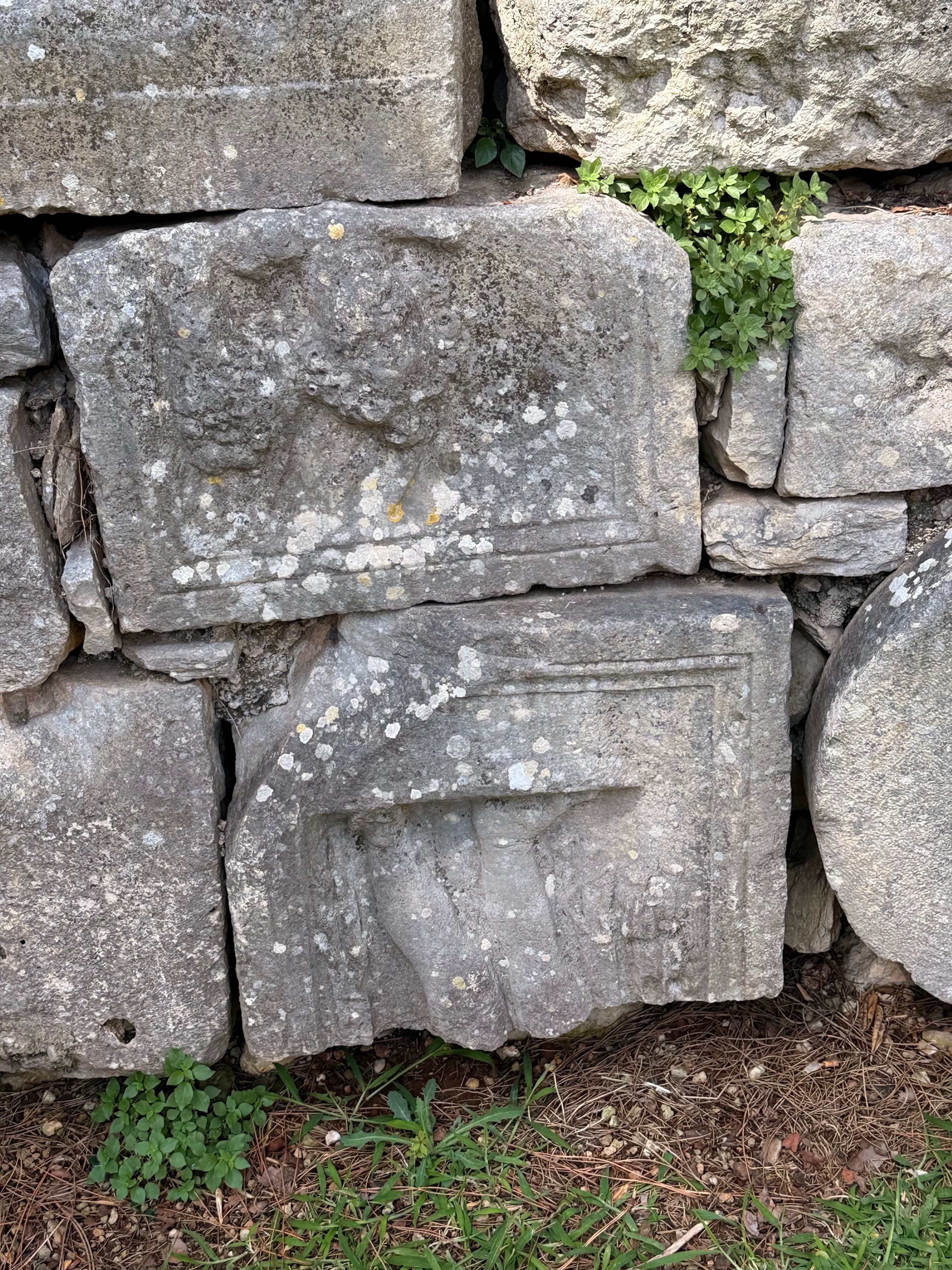
Every day on my tours I point at something that, if I'm honest, looks like a rock. A few rocks, actually - built into a wall, propped against a fence, sitting half-forgotten near a doorway. People glance at them, then look back at me like I've made a mistake. I haven't. Those are pieces of Roman Pula, and once you learn to see them, you can't stop noticing them.
What's actually out there
Walk around the old town slowly enough and you'll spot carved stone fragments wedged into later buildings, lined up in courtyards, or sitting in small collections that function almost like outdoor museums - what archaeologists sometimes call lapidariums. Some are chunks of cornice, the decorative molding that ran along the top of a building. Some have floral or geometric patterns cut into them, the kind of repeating leaf-and-scroll work the Romans loved on anything official or expensive. A few are fragments of sarcophagi, carved stone coffins that would have been covered edge to edge in relief work.
None of these pieces are complete. That's the point, and also why most visitors walk right past them. A single carved block doesn't look like much on its own. It's not a temple, it's not an arena, it's not photogenic the way the Arena or the Temple of Augustus is. It's a chunk of limestone with a leaf pattern on one edge.
Why I still stop for them
Here's how I think about it, and how I explain it on tours: Roman Pula wasn't just the handful of big monuments that happen to still be standing. The city would have been covered - genuinely covered - in carved decoration. Cornices running along rooflines, decorative bands wrapping public buildings, elaborately carved tombs lining the roads leading out of town, inscriptions everywhere. Most Roman cities this size would have had an enormous amount of stone carving, most of it on buildings that are now completely gone.
What survives in Pula today is a small, random sample of all that. Buildings collapsed, got demolished, got reused as quarries for later construction - stone is heavy and expensive, so if you're building a house in the 1500s and there's a perfectly good carved block from a crumbling Roman structure sitting nearby, you use it. That's actually a large part of why some of these fragments ended up where they are: built into medieval walls, houses, churches, not because anyone wanted to preserve Roman art but because the stone was already cut and already there.
So when I point at a cornice fragment sitting in a wall, I'm not asking people to be impressed by the fragment itself. I'm asking them to do a bit of mental reconstruction - to imagine that piece multiplied by however many buildings used to stand here, running continuously along rooflines we can't see anymore, on structures we mostly can't name with any confidence. The fragment is a leftover piece of a decorative vocabulary that covered the whole town, and we're only getting this one surviving word of a long sentence.
Why I don't pretend to know more than I do
I'll be upfront about something: I'm not going to tell you that this specific carved stone came from that specific temple, unless I actually know that, which for most of these scattered pieces, nobody does with certainty. A lot of them were moved, reused, or found without solid context about their original building. Part of being a decent guide, I think, is admitting that uncertainty instead of inventing a tidy story because it sounds better on a tour. The honest version is more interesting anyway: this is a fragment of something bigger that we can mostly only guess at, and that mystery is kind of the whole appeal.
How to actually look at them
My advice, if you're wandering the old town on your own: slow down near any wall that looks older than its neighbors, and check the base of buildings, odd corners, courtyard walls. When you spot a carved piece, don't just register that it's old - try to figure out what part of a building it was. Is it curved, like it wrapped around a column? Flat with a repeating pattern, like it ran along a cornice? Does it have a rougher back, meaning it was meant to be seen from one side only? These little puzzle pieces are scattered all over the old town, quietly waiting for someone to notice they used to be part of something much bigger.