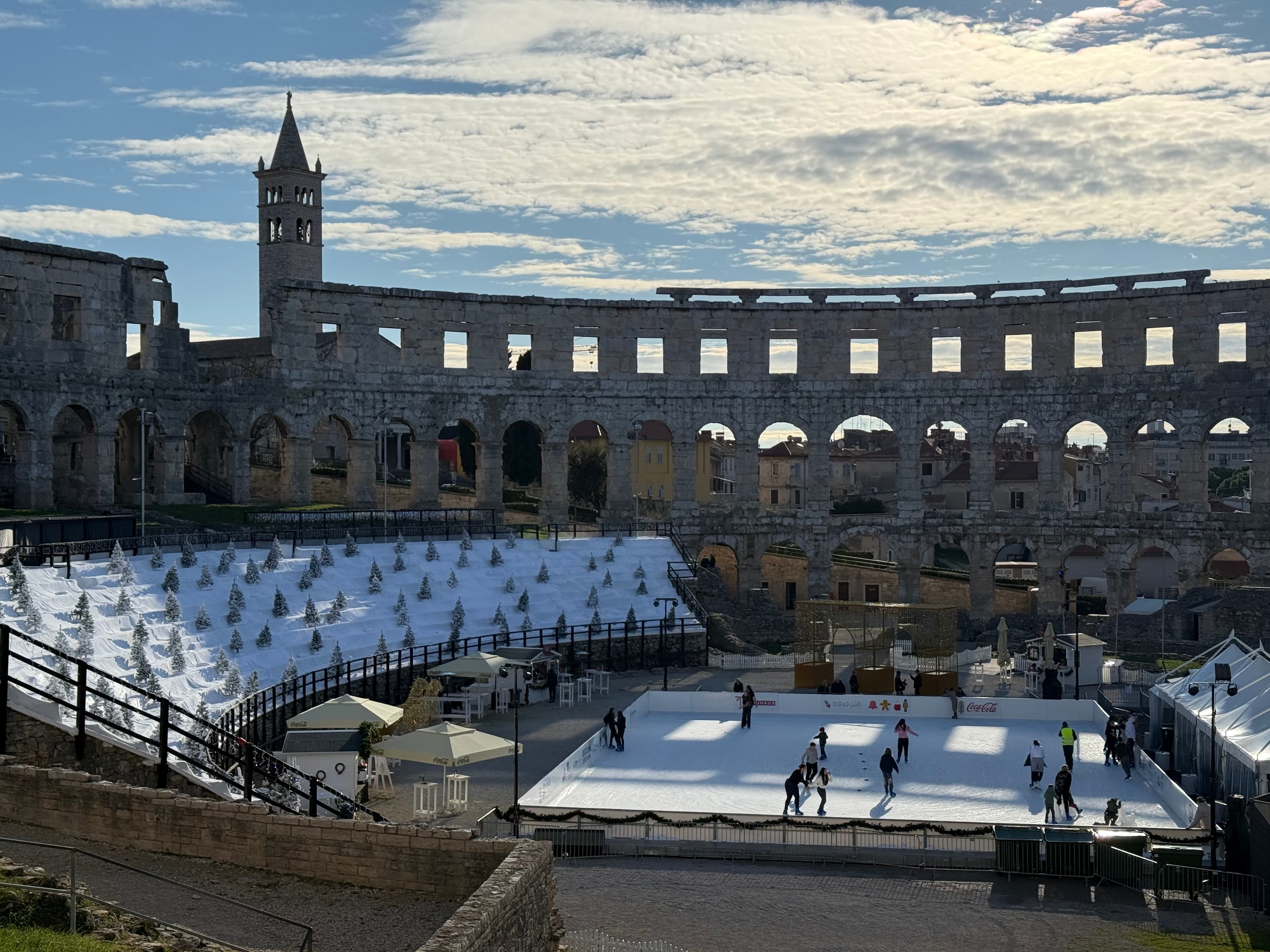
A gladiator arena with a Zamboni problem
Every December, someone drives a resurfacing machine into a two-thousand-year-old amphitheater, and nobody blinks. I've been guiding here for eight years and I still think it's one of the best jokes in Pula: the Romans built this thing for fights to the death, and now for six or seven weeks a year it's full of eight-year-olds in rented skates falling over to pop music.
The Arena doesn't need an ice rink to stay interesting. It's one of the best-preserved Roman amphitheaters anywhere - you can walk the full ring of the outer wall, not just a fragment, which is rare. But winter is when I like it most, because that's when the building stops pretending to be a monument and just acts like what it's always been: a venue. A place where this town puts on a show.
Why this isn't as weird as it sounds
People ask me if the ice rink is some gimmick, a Christmas-market stunt bolted onto a historic site because tourism needs a hook. I get why it reads that way from outside. But the Arena has never actually stopped working. It hosted gladiator fights for a few centuries, then quietly fell out of use, then spent a long stretch as a quarry - medieval Pula literally pulled stone off it to build houses, which is its own kind of recycling nobody puts in the brochure. Later it hosted markets, tournaments, cattle fairs. In the 20th century it became a concert venue and the home of the Pula Film Festival, which still screens movies against that same stone wall every summer.
So the ice rink isn't a break from character. It's the same pattern repeating: a huge open structure in the middle of town, built for crowds, getting reused for whatever the century needs. The Romans designed for spectacle and capacity. They didn't design for skating, obviously, but they built something flexible enough that skating fits without anyone having to apologize for it.
What the Romans didn't plan for
They didn't plan for Pula to shrink from a Roman port city to a small coastal town and then grow again around tourism. They didn't plan for their execution venue to end up printed on fridge magnets. They definitely didn't plan for a Zamboni-style machine - or honestly, for electricity, refrigeration coils under a rink surface, or sound systems blasting Mariah Carey into stone that used to echo with crowd noise for very different reasons.
They also didn't plan for the limestone to hold up this well. That's the part I actually find more impressive than the ice rink. The outer wall survives almost complete because of a lucky accident of Venetian-era preservation politics, not Roman engineering alone - there was a push in the 16th century to stop locals from stripping it for building material, and it worked, mostly. Without that, we might have half an arena and a lot of very old houses made from gladiator-arena stone instead.
If you're coming in winter
If your visit happens to land in the ice rink season, go see it, even if you don't skate. Standing at the top tier looking down at a rink glowing under lights, inside walls the Romans finished around the 1st century AD, is one of those moments where the contrast does all the work - you don't need me to explain it, you just need to be there for five minutes.
Practical note: skating season, hours, and ticket prices change year to year, so check the Arena's own schedule or the tourist board site close to your travel dates rather than trusting anything you read online that isn't current. Same goes for Film Festival dates in summer - different season, different spectacle, same stone.
I'll usually mention this on the walking tour anyway, but if you're wandering on your own: come at dusk when the rink lights are on and the stonework goes orange-grey above them. That's the version of the Arena most postcards don't bother showing you, and it's the one I'd pick.