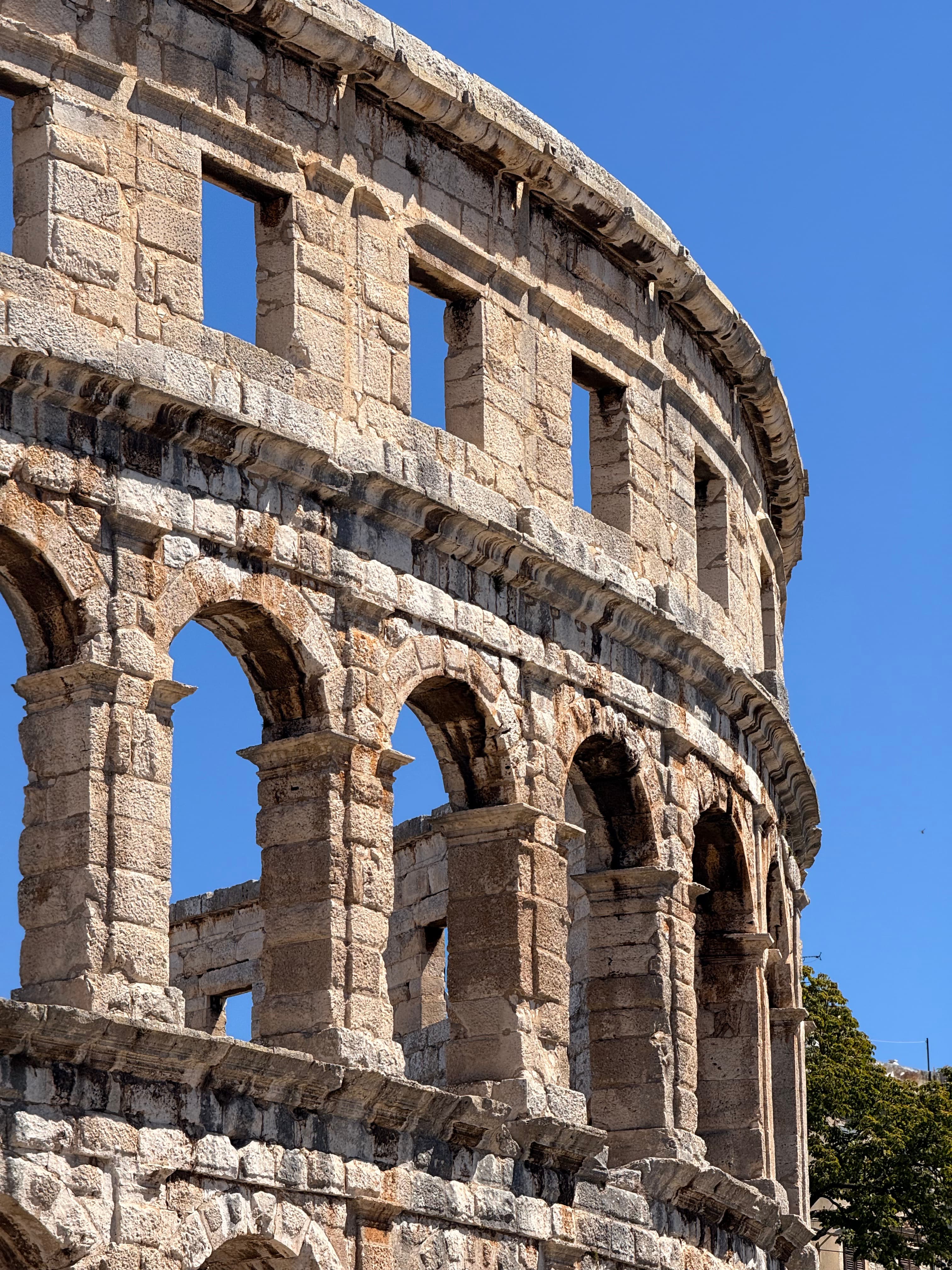
I walk past the Arena almost every day, and I still catch myself looking up at it. Not because it is big, though it is, but because of how much of it survived. Out of more than two hundred Roman amphitheatres that once existed, ours in Pula is one of only a handful where the outer wall still stands complete. The famous ones in Rome, Verona, Arles, they all lost big pieces of their shell centuries ago. Pula kept hers.
The basics, quickly, because you can read them anywhere
The amphitheatre was built in the first century CE, mostly under Emperor Vespasian, the same emperor who started the Colosseum in Rome. It held around 23,000 spectators, which is worth pausing on, because Roman Pula itself had maybe five or six thousand inhabitants. The Arena was never built for the town. It was built for the region, for sailors coming into the harbour, for the whole of southern Istria on festival days.
It measures about 132 by 105 metres, the walls rise a bit over 32 metres on the seaward side, and yes, gladiators really fought here. That part is not a tourist legend.
The four towers, and the detail everyone walks past
Here is the thing I always point out on tours, because nobody notices it on their own. The Arena has four towers built into its outer wall. They are not decoration and they are not defensive. Each tower held a wooden staircase, and at the top, a cistern.
Rainwater was collected on the roof level, stored in those cisterns, and then, this is the good part, it fed a system that could sprinkle scented water over the crowd on hot days. Twenty-three thousand people, sitting on stone in a Croatian summer, and the Romans engineered perfume rain for them. When someone tells you ancient people were primitive, bring up the perfume rain.
The towers also anchored the velarium, the huge canvas awning that sailors, actual navy sailors, would rig across the top to shade the seating. Pula was a harbour town, and rigging canvas was the one skill it never ran short of.
Under the floor
The central floor, the actual arena (the word just means sand in Latin, because sand soaked up the blood, the Romans were nothing if not practical), sits above a network of underground passages. Animals and fighters waited down there before being brought up for the shows.
Today those underground halls hold an exhibition about olive oil and winemaking in Roman Istria, which sounds like a strange pairing until you understand that this is what Istria actually was to the empire. Not a battlefield, not a frontier, but a supplier. Istrian olive oil was famous in Rome itself, amphorae stamped with Istrian marks turn up all over the Mediterranean. The gladiator shows were the entertainment, the olive oil was the economy.
Why it survived when almost every other amphitheatre did not
The honest answer is that Pula got poor at the right time.
After the Western Roman Empire collapsed, most amphitheatres became free building material. Verona's outer ring went into medieval walls. Large parts of the Colosseum went into Renaissance palaces. That is the normal fate of a giant pile of pre-cut limestone standing next to a town that needs houses.
Pula shrank so much through the early Middle Ages, at some points down to a few hundred people huddled around the central hill, that nobody needed that much stone. The Arena was simply too big to eat.
There was one genuinely close call. In the 1580s the Venetian Senate seriously discussed dismantling the entire amphitheatre and rebuilding it in Venice, stone by stone. A senator named Gabriele Emo argued against it and won. There is a plaque honouring him on one of the towers, and honestly, he earned it. Every photo you take here today exists because one Venetian politician said no.
What it is like to visit now
The Arena is still a working venue. Concerts, film festival screenings in summer, opera. I have mixed feelings about watching a pop concert from stone seats where people once watched men fight for their lives, but mostly I think the Romans would approve. It was always a machine for spectacle. It still is.
A few practical things from someone who is there constantly. Go early morning or late afternoon in summer, midday heat on that stone is brutal and the light is flat for photos anyway. The seaward side view from outside, along the riva, is free and it is the best exterior angle. And give the underground exhibition twenty minutes, it is included in the ticket and it is where the actual history of this region lives, in oil presses and shipping amphorae rather than swords.
If you want the fuller story, the Arena is one of the stops where I tend to talk too long on my tours. Nobody has complained yet, but there is still time.