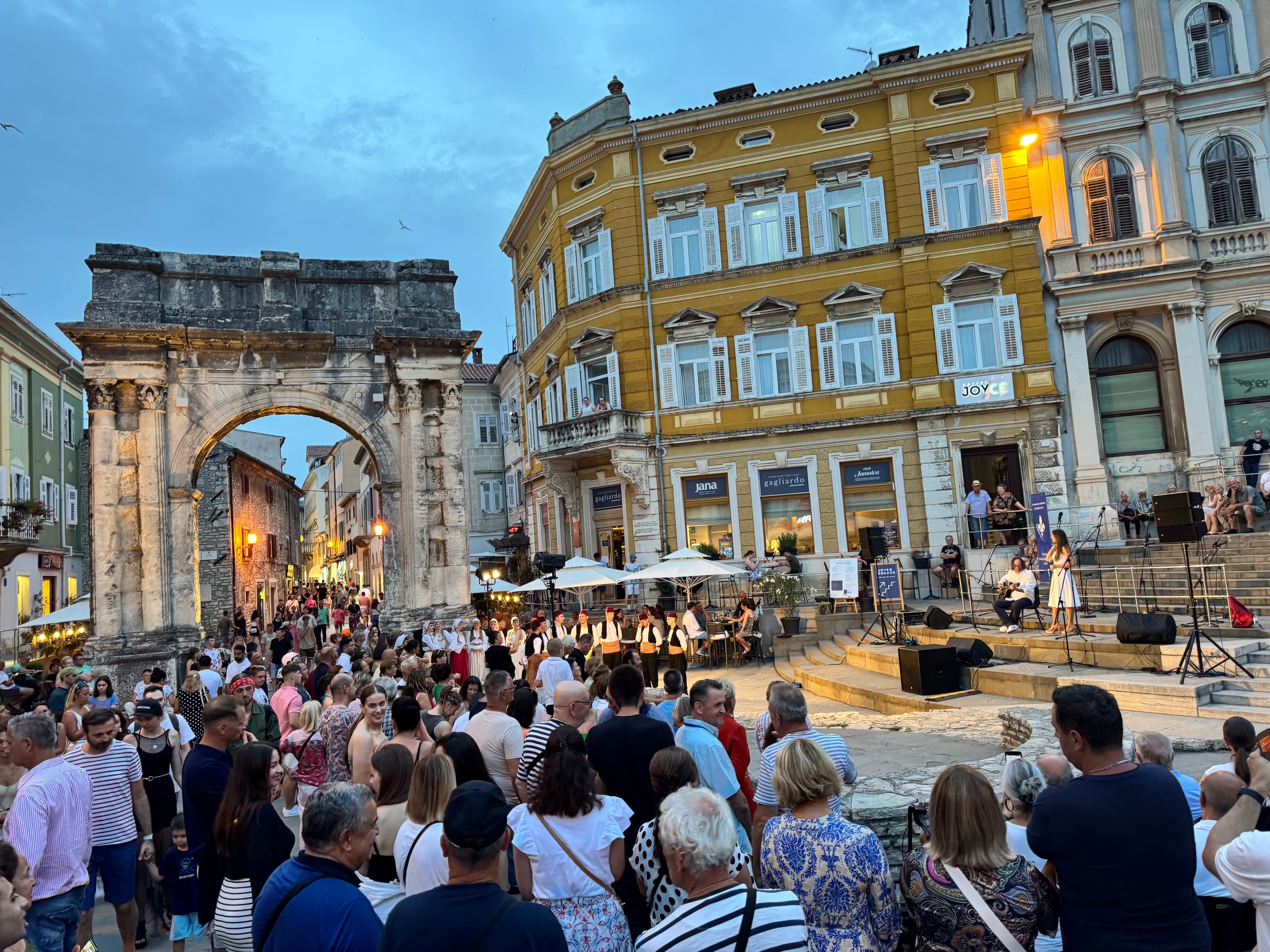
I've walked tourists past the Arch of the Sergii probably two thousand times by now, always in daylight, always explaining the same thing: Roman arch, built for the Sergii family around 27 BC, still standing because Pula just never got around to knocking it down. That's the tour version. The version I actually like is the one that happens after I've said goodbye to the last group and I'm still standing there at nine in the evening with nowhere to be.
The shift happens fast
Daytime around the Arch is tour groups, selfie sticks, someone's kid crying because it's too hot. Then somewhere between seven and eight, depending on the season, the whole thing just turns over. The tour buses clear out, the stone starts giving off that stored heat you only get in July and August, and the cafes along Giardini start dragging chairs out onto the pavement like they're setting a stage nobody announced.
I used to live two streets from here when I was in my twenties, communication degree half-finished, working whatever job paid rent, and I'd come down most evenings just because there wasn't anywhere better to be. Eight years of guiding later and I still do it. Not for work. Because it's genuinely one of my favorite places in this town once the sun's off it.
Who actually shows up
This is the part I try to get across to people on my tours, and mostly fail, because you can't really explain it, you have to sit in it. The crowd at Giardini after dark isn't a tourist crowd and it isn't a locals-only crowd either. It's both, mixed together without anyone making a thing of it. You'll have a table of Pula retirees who've been meeting at the same cafe for twenty years next to four German backpackers who found the spot on a map an hour ago, and nobody's bothered. That mix is the actual local color people pay me to show them, except you can't put it on an itinerary. It just has to be happening when you walk by.
The music nobody schedules properly
In summer especially, there's a decent chance you'll walk past the Arch some evening and hear something live going on, a guy with a guitar, a small group playing somewhere near the square, people just stopped and listening with a drink in hand. It's not always there and it's not some fixed nightly show, so I never promise my groups a concert. What I tell them is: keep your evening loose, walk back through here after dinner, and see what's happening. Half the time it's quiet, just conversation and glasses clinking. The other half you get real, unplanned music bouncing off two-thousand-year-old stone, which honestly beats most paid concerts I've sat through.
Why the Arch specifically works for this
Part of it is just geometry. The Arch sits right where the old town narrows and funnels people through, so in the evening it becomes this natural meeting point before everyone scatters toward dinner or drinks. Part of it is the stone itself, lit up but not aggressively, warm-colored under those lights, so it doesn't feel like a monument you're supposed to admire from a respectful distance. People lean against it, sit on the steps nearby, use it as a landmark to tell friends where to meet. It's been doing that job, one way or another, for two thousand years, which I find quietly funny every time I think about it.
My actual advice
If you're only in Pula for the day, you're missing the better half of it. The Arch and Giardini in daylight are worth seeing, sure, but come back after dinner, order something, and just sit for forty minutes without checking your phone. Nothing's performed for you. Nobody's selling you an experience. It's just a town having its evening, same as it's had for longer than anyone can really account for, and you happen to be there for it.
That's the Pula I actually like showing people, even when I can't technically put it on the tour.