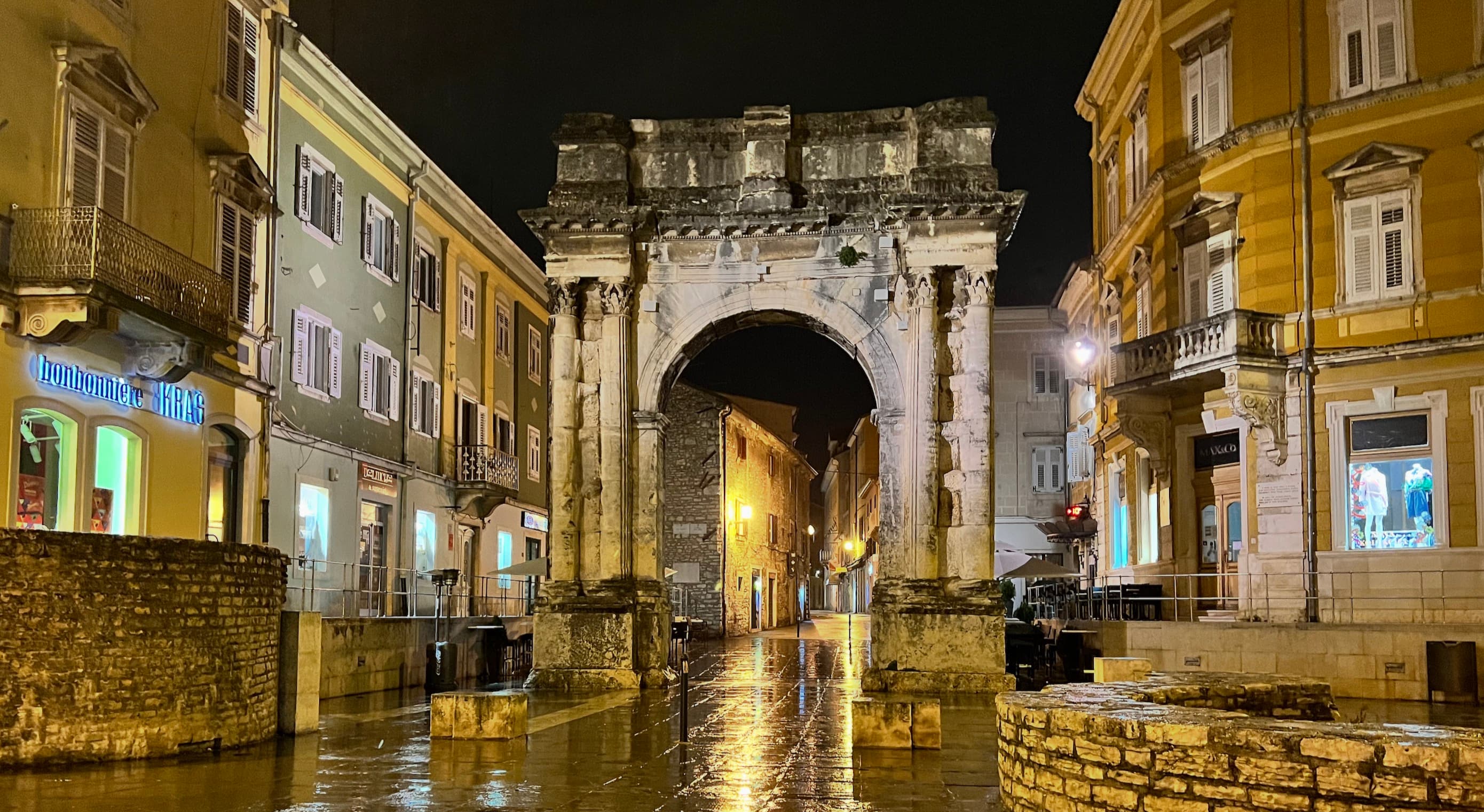
When Women Paid for Monuments
Walk through almost any Roman city and you'll read the same names carved in stone: emperors, generals, magistrates — men. But look closer, and a quieter story emerges. In the shadows of the public record stand women who funded temples, porticoes, and monumental arches with their own money. They were rare, but they were not invisible. And nowhere is their agency clearer than on a single arch at the edge of the Adriatic, in Roman Pula (Pola).
This is the story of female patronage in the Roman world — a form of power women exercised not through office, which they were denied, but through wealth, memory, and the deliberate shaping of public space.
The Rules Women Had to Work Around
Roman women could not hold magistracies. They could not vote, command legions, or sit in the Senate. Public honor was, by law and custom, a male arena. Yet Roman law did permit women — especially widows and heiresses — to own and control substantial property. That legal loophole became a cultural instrument.
A wealthy widow could do what a living male official often could not: commission a lasting public monument in her family's name. When she did, the inscription almost always underlined one detail — de sua pecunia, "with her own money." That phrase was not an accounting note. It was a statement of independent agency, proof that a woman had funded, and therefore authored, a piece of the civic landscape.
Eumachia, Mineia, and the Pattern of Patronage
Salvia Postuma was not alone. Across the empire, a handful of remarkable women left their mark:
- Eumachia of Pompeii, a priestess and businesswoman, financed a vast public building on the Forum of Pompeii in the early 1st century CE. Her name is carved on it in letters as large as any magistrate's.
- Mineia of Paestum funded a basilica and appeared on the city's coinage — an extraordinary honor for a woman.
- Plancia Magna of Perge, in Asia Minor, rebuilt the city's monumental gate and filled it with statues, styling herself a civic benefactor on the grand scale.
Set against this pattern, Salvia Postuma fits a recognizable type of the Roman female patron: wealthy, well-connected, and strategic. But her monument in Pula stands out for one reason — it survives almost intact, letting us read exactly how a woman used art to speak.
The Arch of the Sergii: A Woman's Commission
Just inside the Porta Aurea of ancient Pola, Salvia Postuma raised a memorial arch to three deceased men of the Sergii family, into which she had married. Her dedicatory inscription runs across the frieze: Salvia Postuma Sergi de sua pecunia. Her name appears a second time on the attic, and her statue once stood there alongside the men she honored.
That double signature matters. Most Roman monuments erased the woman behind them. Salvia Postuma did the opposite — she wrote herself into the composition, as dedicant, financier, and author of its meaning.
For the full biography of Salvia Postuma and the men she memorialized, see our companion piece: Salvia Postuma: The Woman Who Commissioned the Arch of the Sergii.
Patronage as a Language of Power
What makes Salvia Postuma a case study rather than a curiosity is how deliberately she used her commission. Every choice on the arch carries intent:
- She adopted the imperial visual vocabulary of Augustus — facing Victories, trophies, solar gryphons and sphinxes — aligning her private family with the emperor's public triumph.
- She wove in personal grief, most strikingly through the goddess Aurora, the mythic model of a mother mourning a fallen son.
- She placed her own name on the same compositional axis as the arch's most intimate images.
In other words, she used patronage the way male magistrates used office: to claim status, declare loyalty, and secure remembrance. Denied the cursus honorum, she built her honors in stone instead.
To decode the arch's rich funerary and imperial symbolism in detail, read: Heroization and Funerary Symbolism on the Arch of the Sergii.
Why This Still Matters
The women who funded Rome's monuments remind us that power in the ancient world was never as one-dimensional as the official record suggests. Through wealth and vision, a widow in a provincial colony could speak the same visual language as the emperor in Rome — and be heard.
When you stand before the Arch of the Sergii in Pula today, you are looking at one of the best-preserved statements of female patronage in the Roman world. It is not just a monument to three dead men. It is the signature of the woman who built it.
Want to see Salvia Postuma's arch in person and hear the full story on-site? Join our walking tour of Pula — it's where these stones start talking.
Sources:
- Alka Starac, "The Messages of the Arch of the Sergii," Histria archaeologica 51 (2020), pp. 5–63.
- Margaret L. Woodhull, "Matronly Patrons in the Early Roman Empire: The Case of Salvia Postuma," in Women's Influence on Classical Civilization (Routledge, 2004), pp. 75–91.
- Robert Matijašić, "Salvija Postuma," Istarska enciklopedija.